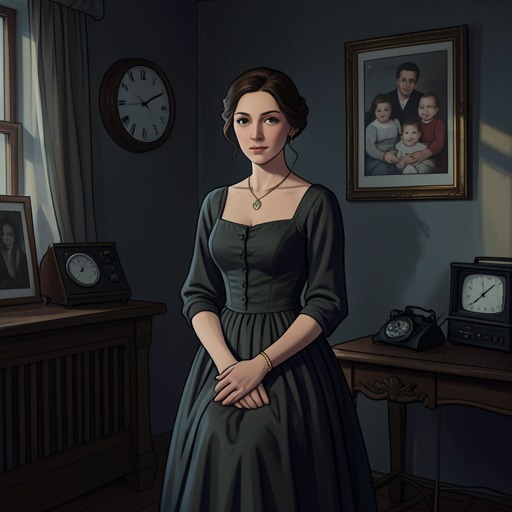
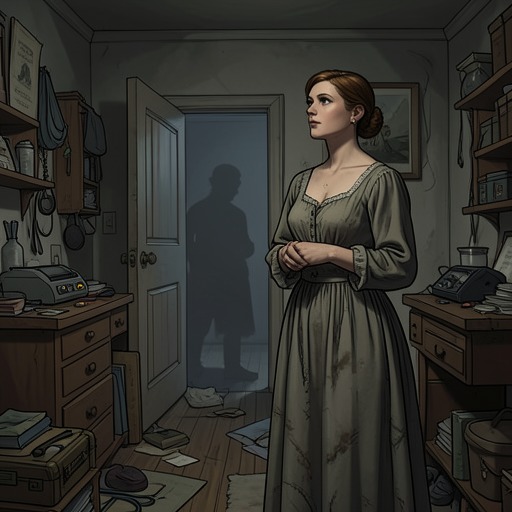
Betty
The Glass MenagerieBetty, Jim O’Connor’s girlfriend and fiancée, is an offstage character whose late disclosure changes the meaning of his visit to the Wingfield apartment. Although she never appears, Jim’s account of their courtship and impending marriage turns Amanda’s expectation that he might become Laura’s husband into a painful misapprehension, exposing the distance between the family’s hopes and the life he has already chosen.
Identity and Background
Jim describes Betty as a home-girl, Catholic, and Irish, and says that they get along well in many ways. They met the previous summer on a moonlight boat trip up the river to Alton aboard the Majestic. He recalls that their relationship became love right away, and says that being in love has made a new man of him. His description presents Betty through Jim’s account rather than through any independent appearance or speech: she is known as the person with whom he is going steady, the woman who shares his outlook in important respects, and the source of the romance he says has changed him.
The river excursion gives their relationship a specific origin and a contrast with the Wingfield household. Jim’s story of meeting Betty on a boat trip belongs to a world of movement and courtship beyond the apartment, while Betty herself remains absent from the stage. That absence matters: she enters the family’s evening not as a guest but as a fact about Jim’s life that the family did not know.
Relationship with Jim
Jim first discloses the relationship in direct response to Amanda’s question about his evening schedule. When she asks whether he works at night as well, he explains that his second time-clock is for Betty. He then makes clear that she is the girl he goes steady with. The casual answer sharply revises the impression Amanda has formed during an evening organized around welcoming and impressing him as a possible gentleman caller for Laura.
Jim describes the relationship in confident, settled terms. He says he and Betty fell in love from the beginning, and that love has changed his life. He later confirms that they are to marry on the second Sunday in June. Although the engagement has not yet been announced at the warehouse, he says, his commitment is definite. The specific wedding date converts what might have sounded like a passing romance into a near-future marriage, leaving little room for the hope that he might instead become available to Laura.
The Wingfields’ Expectations
Betty’s importance is partly established by what the Wingfields need a suitor to mean. Amanda fears that Laura will drift through life without work or a secure future. She recalls that business college frightened Laura into illness and that the Young People’s League proved another failure: Laura spoke to nobody, and nobody spoke to her. In Amanda’s view, Laura’s remaining activities are handling pieces of glass and playing the worn-out records left by her father. She worries that, without a career or marriage, her daughter will face lifelong dependence and the humiliations of unmarried women supported reluctantly by relatives.
Amanda accordingly links Laura’s independence to marriage and a home of her own. She tells Tom that he may leave only once Laura has someone to take his place in caring for her; until then, Tom must look out for his sister. A gentleman caller therefore represents more than romantic possibility: he is imagined as the person who could provide Laura with a household and release Tom to pursue his own plans. Betty’s engagement to Jim reveals that this solution was never available through him, however much the family’s preparations suggest otherwise.
The household’s preparations make the expectation concrete. Amanda insists that the wedding silver be polished, the monogrammed table linen laundered, the windows washed, and fresh curtains put up. She calls Jim the first young man introduced to Laura and laments that Laura has never received a single gentleman caller. Amanda even places wrapped powder puffs in Laura’s bodice, naming them “Gay Deceivers,” and insists that Laura wear them when Laura objects. Betty’s engagement makes the evening’s careful staging—its cleaned rooms, formal table, and managed appearance—look increasingly like an elaborate welcome arranged without knowledge of the guest’s actual circumstances.
Revelation and Significance
Jim’s disclosure reaches Amanda after the evening has already carried the possibility of a match for Laura. When he mentions Betty, Amanda repeats the name in surprise and asks whether the romance is serious. Jim answers with the wedding date. The revelation is dramatized as a sudden collapse of expectation: a cracking sound is heard in the sky, and the screen legend announces, “The Sky Falls.” Betty’s unseen engagement thus changes the emotional meaning of the gathering before she has appeared in it at all.
The contrast is especially sharp because Amanda’s plans treat marriage as both personal hope and practical provision, while Jim’s marriage to Betty is already a settled commitment in his life outside the apartment. He calls Betty his home-girl, a description that echoes the category Tom tentatively uses for Laura, but Jim’s account does not make the two women interchangeable: Betty is the woman he loves, dates regularly, and intends to marry. The distinction exposes how little the family knows about Jim while investing him with a future role of its own imagining.
Betty remains outside the stage action, but her relationship with Jim is the decisive fact that ends Amanda’s hopes for the evening and undercuts the prospect that he might secure Laura’s future. She functions not as a rival who confronts Laura, but as the absent reality against which the family’s carefully prepared illusion of a possible match breaks. Her engagement also leaves Amanda’s central problem unresolved: Laura still has no career, caller, or independent home, while Tom’s freedom remains tied to the provision Amanda believes his sister needs.